

The ultimate question in sales and marketing is simple: How can we accurately predict who is ready to buy?
Today, there are numerous tools, data sources, and predictive models designed to answer that question. However, not all data carries the same weight. Understanding which signals truly indicate buying intent is essential for improving conversion rates and maximizing ABM performance.
We reviewed DiscoverOrg’s survey regarding the predictive ABM buyer, and here is what we found.
7 Important Findings to Understand the Predictive ABM Buyer
-
Fit, Intent, and Opportunity are three types of predictive data that together create buying momentum.
-
When predictive signals are present, 95% of respondents report positive revenue impact, with increased conversion rates as the most common benefit.
-
Although most firms do not use Intent or Opportunity data, these data points rank highest on the “most predictive” leaderboard.
-
Job title and department budget are the most predictive Fit data elements.
-
Marketing teams place less emphasis on hiring and personnel signals than sales teams.
-
The “secret sauce” in prediction formulas includes understanding your prospect’s tech stack.
-
Only 20% of respondents use predictive data to support their ABM initiatives, despite widespread interest.
Let’s examine each finding more closely.
FINDING 1: Fit, Intent, and Opportunity Work Together to Predict Purchase
To understand predictive ABM properly, we must first clarify the types of data that influence purchase decisions. Relying on a single signal rarely delivers accurate forecasts.
Behavioral data can only predict future behavior when paired with clearly defined firmographic and demographic characteristics aligned with the Ideal Customer Profile (ICP).
The right contact at the right company must meet specific criteria. Any scoring or predictive analysis requires a fully defined company profile. If the company is not a good fit, even strong behavioral signals lose value.
Fit includes contact-level data such as Title, Department, Job Role, and Job Level. Without a clearly defined ICP covering both company-level and contact-level criteria, sales teams risk spending time on opportunities that never close.
Opportunity Insights (Favorable Conditions)
A prospect may encounter a solution at the right moment. However, timing should not rely on luck. When Opportunity or “trigger” data is layered on top of Fit and Intent data, it becomes a strong predictive factor in the purchase equation.
These data points indicate that the timing is right for change.
Intent Data (Implicit Behavior)
Once firmographic and demographic foundations are in place and favorable conditions are identified, Intent data becomes highly valuable. Intent reflects behavioral activity that connects target buyers and accounts to a solution or related topics.
Examples include:
-
Form submissions
-
Content downloads
-
Event registrations
-
Page views
-
Time spent on the page
-
Number of visitors from an account
These digital footprints signal active research and potential buying intent.
FINDING 2: Predictive Signals Correlate with Revenue Growth
The next question is whether predictive data translates into measurable results. The survey findings provide a strong answer.
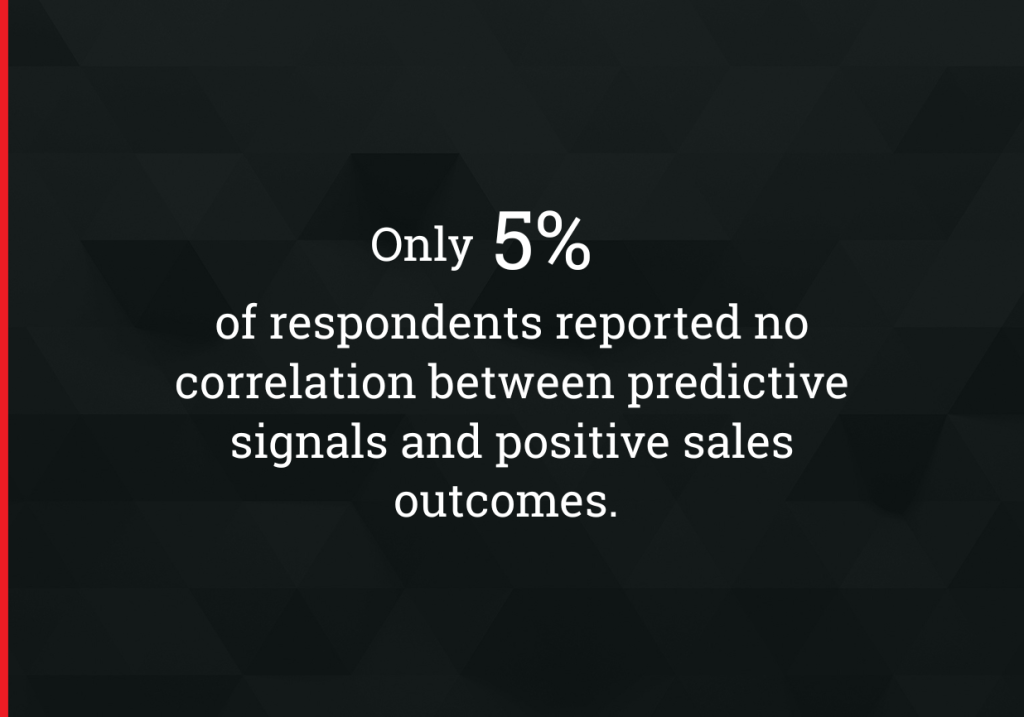
This means 95% were able to connect predictive indicators to revenue growth.
The most frequently cited benefit was higher conversion rates from prospect to qualified lead. Interestingly, other potential outcomes, such as shorter sales cycles, higher deal values, or more demos, were not consistently highlighted.
This suggests two important conclusions:
-
Many businesses struggle to track predictive impact across the full sales funnel.
-
Predictive data may open doors, but it does not close deals. Even when a buyer appears to be a strong fit with high intent, sales execution remains critical.
FINDING 3: Intent and Opportunity Data Rank Highest Yet Remain Underutilized
Although Intent and Opportunity data rank among the most predictive signals, most companies have not fully invested in them.
The top predictive data points focus on buyers’ online research behavior. Yet many organizations still rely primarily on basic firmographic data.
Opportunity-related signals (such as identifying RFPs or planned initiatives) are also highly predictive. Access to these insights can provide early entry into buying conversations. However, companies use this data less frequently than expected.
This gap represents a significant opportunity for competitive advantage.
FINDING 4: Job Title and Department Budget Are Critical Fit Indicators
Fit data forms the foundation for evaluating prospects and accounts. If fundamental criteria are missing, such as targeting the wrong department or one without a budget, the likelihood of closing decreases significantly.
The buyer’s technology profile is another highly predictive Fit factor. This includes technologies that integrate with or complement the seller’s solution.
Technology attributes are so influential that they account for four of the top seven most predictive data points.
FINDING 5: Sales and Marketing Interpret Personnel Signals Differently
A noticeable difference emerges between how sales and marketing teams interpret predictive signals.
Sales professionals interact daily with individual contacts. When a prospect leaves a role, an opportunity may stall. When a key position is filled, it creates a new opening for engagement.
Marketing teams often place less emphasis on these hiring and staffing signals. However, they represent valuable moments to increase brand visibility and targeted outreach.
For example:
-
A new executive appointment
-
Major hiring announcements
-
Rapid team expansion
These events can trigger strategic marketing campaigns aligned with sales outreach.
FINDING 6: Understanding the Prospect’s Tech Stack Strengthens Predictive Accuracy
Another major factor in predictive accuracy is knowledge of the prospect’s technology environment.
Sales teams often prioritize accounts ready to purchase immediately, while marketing focuses on identifying early intent signals. However, integrating tech stack insights strengthens both approaches.
When marketing actively targets prospects aligned with the Ideal Customer Profile (including technology compatibility) marketing-sales alignment improves. Lead quality increases, and funnel conversion rates become stronger.
FINDING 7: Predictive Data Adoption in ABM Remains Low
Despite the attention surrounding ABM and predictive analytics, adoption remains limited.
Only 20% of respondents report using predictive data to support their ABM initiatives. Additionally, only 30% score leads based on purchase likelihood.
Even more concerning, just 28% use predictive data to clean or remove inaccurate records from their systems.
Without prioritizing database health:
-
Data quality declines
-
Teams feel overwhelmed
-
Decision-making becomes less reliable
Predictive data only delivers value when it is actively maintained and applied.
Conclusion
B2B purchases occur at the intersection of accurate Fit, Intent, and Opportunity data.
Winning sales and marketing teams integrate these three data categories to:
-
Identify target accounts
-
Prioritize high-value opportunities
-
Monitor buying signals
-
Engage at the right time with the right message
Predictive data does not replace strategy or execution. Instead, it sharpens focus, improves prioritization, and increases the likelihood of meaningful engagement.
If you would like to see how NNC’s sales and marketing intelligence platform uses precise Fit, Intent, and Opportunity data to help teams identify and prioritize accounts most likely to purchase, schedule a demo today.