

The past year has shown us the importance of digital training. Increasingly, B2B companies today are adopting an eLearning approach for their B2B digital training. Not only that, but marketing skills have also shifted dramatically in the past couple of years. In this article, you will not only learn how companies are using B2B digital training to its best extent, but also:
- How skills in marketing have shifted in the last couple of years
- Upskilling and reskilling
- Microlearning
- Gamification
- Learning Management Systems (LMS)
After that, we’ll go over a few conclusions about the current state of B2B digital training and why it should be the choice for you.
How skills in marketing have shifted in the last couple of years
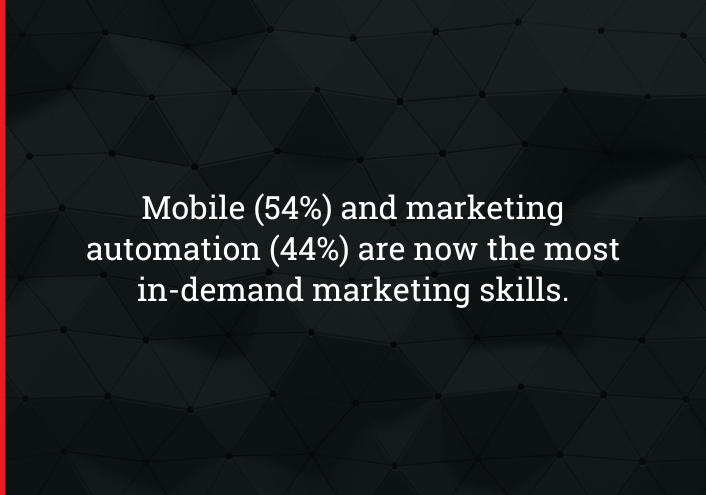
Marketing skills are shifting. Mobile, marketing automation, and social media skills are far more important nowadays. It seems that in the next couple of years, marketing automation will become one of the most well-paid and important skills.
Microlearning
Learning in small doses is the way of the future. Art Kohn has written in his book “Brain Science: The Forgetting Curve” that within an hour, people will, on average, forget half of all the information that was presented to them. After 24 hours, 70% of the information will be forgotten, and within a week, it will go up to 90%.
That information has made several companies head toward a microlearning approach. But what is microlearning? While there’s no official microlearning definition, all microlearning-based training shares one key characteristic: being very, very short. This could either be small learning units or short-term learning activities.
Microlearning delivers short bursts of content for learners to study at their convenience. Content can take many forms, from text to full-blown interactive multimedia, but should always be short.
Here are some microlearning content examples:
- Text (phrases, short paragraphs)
- Images (photos, illustrations)
- Videos (of the short variety)
- Audio (short snippets of speech or music)
- Tests and quizzes
- Games (e.g., simple single-screen challenges)
Gamification
One of the best ways to learn new things is by disguising them as “not work.” By making training fun, it is much easier for people to learn new things.
Gamification is the application of game-design elements and game principles in non-game contexts. It can also be defined as a set of activities and processes to solve problems by using or applying the characteristics of game elements.
Games and game-like elements have been used to educate, entertain, and engage for thousands of years. Some classic game elements are:
- Points are used as visual identifiers of progress
- Badges display achievements
- Leaderboards are used to present competitive placement
Blended learning
Blended learning is an approach to education that combines online educational materials and opportunities for interaction online with webinars. It requires the physical presence of both teacher and student, with some elements of student control over time, place, path, or pace.
When applied to B2B digital training, blended learning usually involves:
- A portion of the learning occurs online, with the student being able to manage the pace at which they learn
- Another portion of the learning is instructor-led, usually conducted through webinars, allowing remote learners to engage more easily
Blended learning is beneficial for B2B businesses because:
- It reduces face-to-face training costs, such as travel, accommodation, and printed training materials
- Companies can use varying eLearning methods, such as webinars, gamification, etc., which result in better learner engagement
- Blended learning is a more efficient and cost-effective way to train; you’ll see a quicker and greater return on investment
- It’s also easier to track exactly who has or hasn’t completed training
Upskilling and reskilling
Let’s take marketing automation, one of the fastest-growing skills in importance.
To give you an idea of how important marketing automation is about to become: by 2025, at least a quarter of companies will merge marketing and sales into one single department, which will report to marketing automation.
About 75% of companies are struggling with recruiting qualified marketing technology employees, especially since marketing automation is a relatively recent concept, while also growing at an incredibly rapid rate. 55% of companies that don’t use marketing automation say it’s because they do not have the expertise to do so. So what can you, as a B2B organization, do?
One way is to partner up with agencies that already do this well and can help you ramp up the skills of your team while also helping you throughout the process.
“Agencies are a prime source of external perspective and innovation for martech teams.” – Gartner, 2020
Learning Management Systems
A Learning Management System (LMS) is a software application or web-based technology used to plan, implement, and assess a specific learning process. It is used for eLearning practices and, in its most common form, consists of two elements: a server that performs the base functionality and a user interface operated by instructors, students, and administrators.
Typically, an LMS provides an instructor with a way to create and deliver content, monitor student participation, and assess student performance. It may also provide students with the ability to use interactive features such as threaded discussions, video conferencing, and discussion forums.
LMS platforms are beneficial to a wide range of organizations, including higher education institutions and corporations. The primary use of a learning management system is for knowledge management (KM). KM refers to the gathering, organizing, sharing, and analysis of an organization’s knowledge in terms of resources, documents, and people skills. However, the specific role of the LMS will vary according to the organization’s training strategy and goals.
Popular enterprise-level LMSs include Adobe Captivate Prime, Docebo LMS, TalentLMS, iSpring Learn, and eFront.
Use cases in corporate environments:
- Employee training and onboarding: LMSs are used to help train new employees by providing opportunities to access training materials across various devices. New employees can be recognized when they add their knowledge and feedback, helping employers understand how effective the training courses are and where additional support may be needed.
- Extended enterprise training: Includes customer, partner, and member training. Common in software and tech companies, where users need to learn how systems work before using them.
- Employee development and retention: LMSs are used to assign courses that help current employees build job skills, stay informed on product changes, and meet compliance requirements.
Thoughts on B2B Digital Training
Marketing skills have shifted in the past couple of years. Areas such as social media marketing, mobile marketing, or marketing automation are much more valuable now than they were a few years ago, with marketing automation well on its way to becoming the most important marketing skill you can have.
At the same time, many companies have trouble finding qualified marketing automation employees due to the lack of people who possess such skills. There are many ways to start B2B digital training nowadays. It can be done through blended learning, microlearning, gamification, learning management systems, or even a mix of the four.